outpace them, not outsmart them - heavy metal pricing agility
companies like Lovable change pricing every 6 weeks, OpenAI reintroduces new models every month; Salesforce did two pricing changes this year - pricing agility is the key, no matter who you are

hello world,
Not gonna lie, today’s episode of AI Monetization is all about “making things fast” instead of always “making things right”.
We’re covering the most important trend identified by Kris Szyszkiewicz, co-founder and Partner at Valueships, called “pricing agility”. Starting from the professor-like definition:
”Pricing agility is the ability to align your pricing with strategic needs, competitor moves, and your overall business situation.”
Here is the thing: the overall business situation changed dramatically. And we’re covering how you can make it happen, and what needs to change to be better at monetizing in the AI world:
why Jurgen Klopp is a pricing expert;
main pricing agility governance framework;
what are your non-negotiables in making pricing agility happen
I also have a whole podcast episode, avaialable on Spotify, and Apple as well. Of course, hosted it on Substack RSS as well:
#3 heavy metal pricing - why agility is the key now

#3 heavy metal pricing - why agility is the key now
6 months for pricing change is market standard now
Previously, the company that was “good in pricing” used to change prices at least once a year; the best ones were changing something twice a year. Now, a 6-month change is a new market standard.
Whoever you are, you can’t afford static pricing anymore - this also creates pressure for companies like Valueships. We can’t produce a 16-week study and implement it in the next month: we are going for less research, more testing, fewer big bets, and more low-hanging-fruit optimization.
To give you an example: previously, changing a value metric was revolutionary; now you simply add a consumption layer to a previously subscription-based model. It’s ironic, to be honest, because very often we heard pushback from the clients:
“customers hate changes in billing models” - true
“it will affect current revenue streams” - also true
“it’s hard to implement” also very true
But unfortunately, market dynamics changed. When key players are changing the playing field, you need to adapt.
We have recently seen this in the World Cup, where players like Ronaldo and Messi (even though he somehow managed to get into the final) were simply not playing in a modern way. Let me bring an example of my favorite coach: Jurgen Klopp introduced “heavy metal football”
He made his style, defined by his signature "heavy metal football" - a high-intensity, aggressive style of play built on relentless pressing, quick transitions, and ferocious counter-attacks.
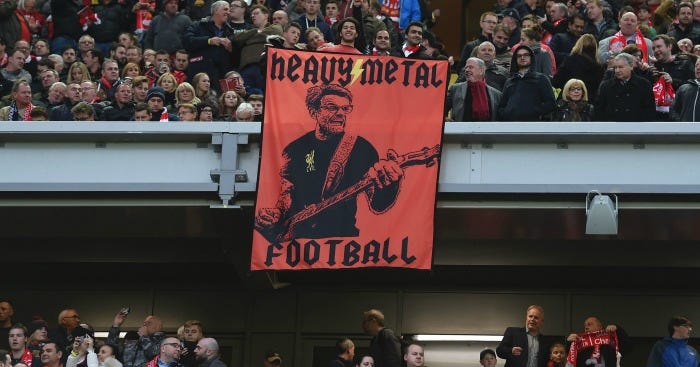
Invented at Borussia Dortmund and later mastered at Liverpool, this approach changed the way football was played. It was quick, fast-paced, with one key theme in mind: to take over the playing field and score more goals than the opposite team.
The key theme was agility and change. And he delivered: he won Liverpool its first Premier League title in 30 years and the Champions League as well.
Now, to pricing. Best players don't change pricing every 18 months as they used to; now, 6 months is effectively a market standard. It's like counter-attacking and always pressing at the same time.
Pricing agility is more important than making it right all the time. In other words, you simply can't afford to be static anymore. Do we really believe all pricing decisions made are good? Absolutely not, but these teams are making them anyway.
When the world is changing around us, we can also do it by applying two-part tariffs, using AI add-ons to push usage-based, and transforming our revenue streams, ensuring the barrier of entry is lower than "annual subscription", while also maintaining the defense position on current revenue streams.
pricing trailblazers are already there
And honestly, I need to provide some good examples to put the money where my mouth is. Here are some from the trailblazers you should know of, and by the way, if you’re new to pricing, I’m quoting this from Kyle Poyar who did the data research, but I think I can give it another spin and focus on what matters the most: value.
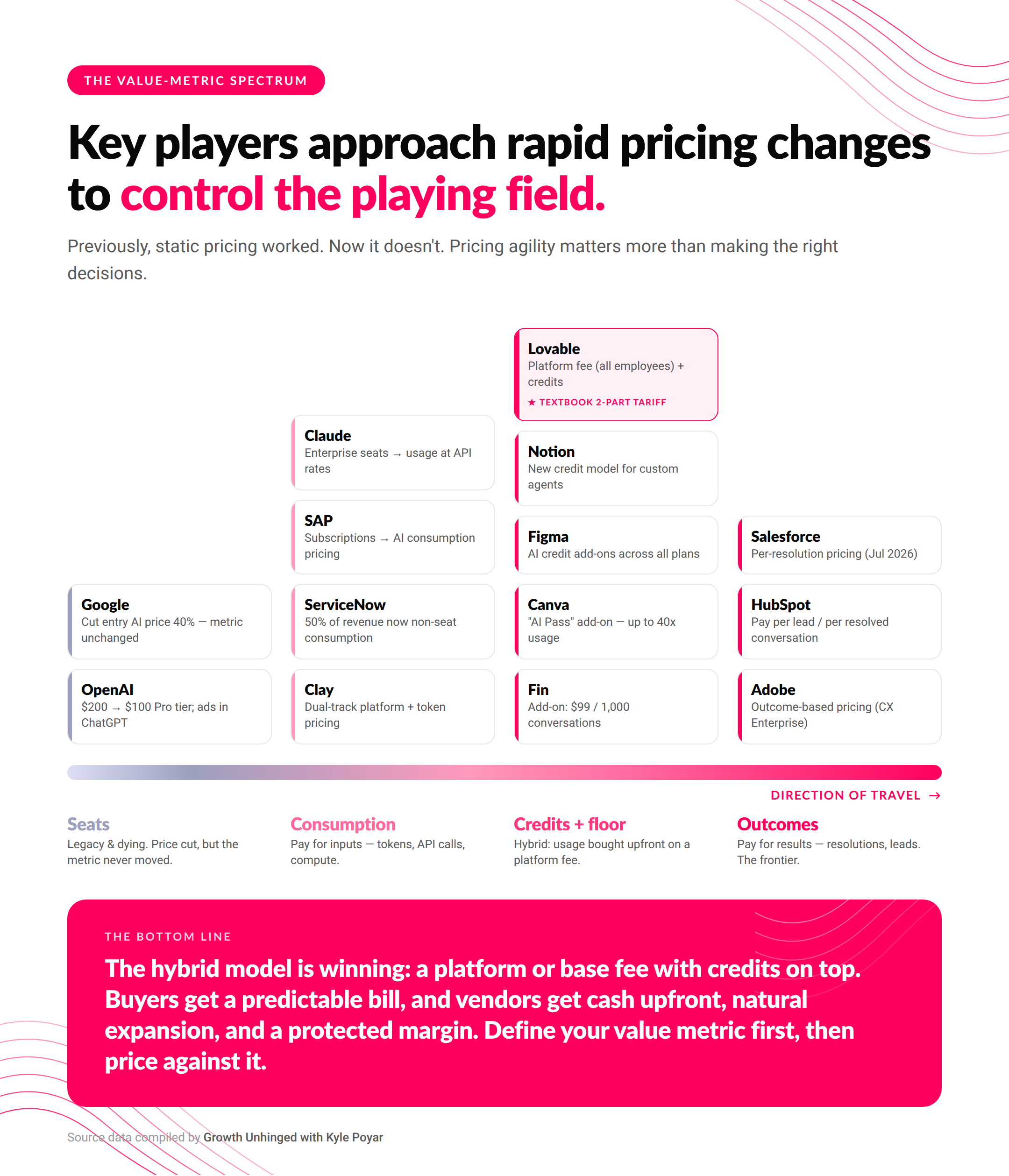
The real pattern is a decoupling of price from seats and a re-coupling to value delivered. While GenAI disruptors adapt usage-based pricing from day 1, old-school SaaS incumbents are experimenting with RE-OCCURING (a good term I would call it, even highlighted as not existing as a word yet) revenue to defend their business and also monetize the user base more irregularly.
What’s actually changing rapidly:
Per-seat → consumption (inputs). Pricing the resource used: tokens, API calls, compute. Clay’s token pricing, Claude at API rates, SAP’s consumption shift, ServiceNow’s non-seat revenue. This is the raw “usage-based”
Consumption → outcomes (results). Pricing the result, not the input. Salesforce per-resolution, HubSpot pay-per-lead / per-resolved-conversation, Adobe’s outcome-based CX. This is a different animal from usage; because you’re not billing for what was consumed, but rather billing for what was accomplished.
The packaging layer that ties it together: credits + a platform fee. Notion, Figma, Canva, Lovable, Fin.
As you can see, the good-better-best license-based pricing is maybe not dead, but definitely needs a bigger house renovation.
Here’s the part most people miss: the market is not converging on pure usage-based. The reasons are very tactical; first of all, pure usage is unpredictable for the buyer (nobody wants a surprise invoice), and pure outcome-based needs clean attribution that barely exists yet - these two dichotomous relationships make it not feasible for business.
Therefore, the actual landing spot is the hybrid — a two-part tariff: a base/platform fee plus consumption, usually wrapped as credits bought upfront.
Credits are just usage-based pricing paid in advance, and that’s why they’re winning, and winning a lot! Cash paid upfront, natural expansion as customers burn through them, and a margin floor from the base fee. Check recent Lovable’s move, and I would even call it a modern textbook version. You get a good “platform fee covering all employees, plus credits”. It is literally a 2-part tariff explained as simply as possible. Salesforce, Atlassian, and Clay are all doing the same thing.
So the one-line answer: don’t go into pure“usage-based” — it’s “value-metric-based, delivered as hybrid credit systems with a platform floor, with outcome-pricing as the frontier. However, outcomes are possible only if you have clear attribution. For most, they need to be fine with a good credit-based system tied to a good value metric. While the travel takes us to experiment with pay-as-you-go models and we want more of it, there we have a business to defend.
OK, OK, but how to actually implement it? Fabrizio Romano: here we go!
pricing agility governance framework
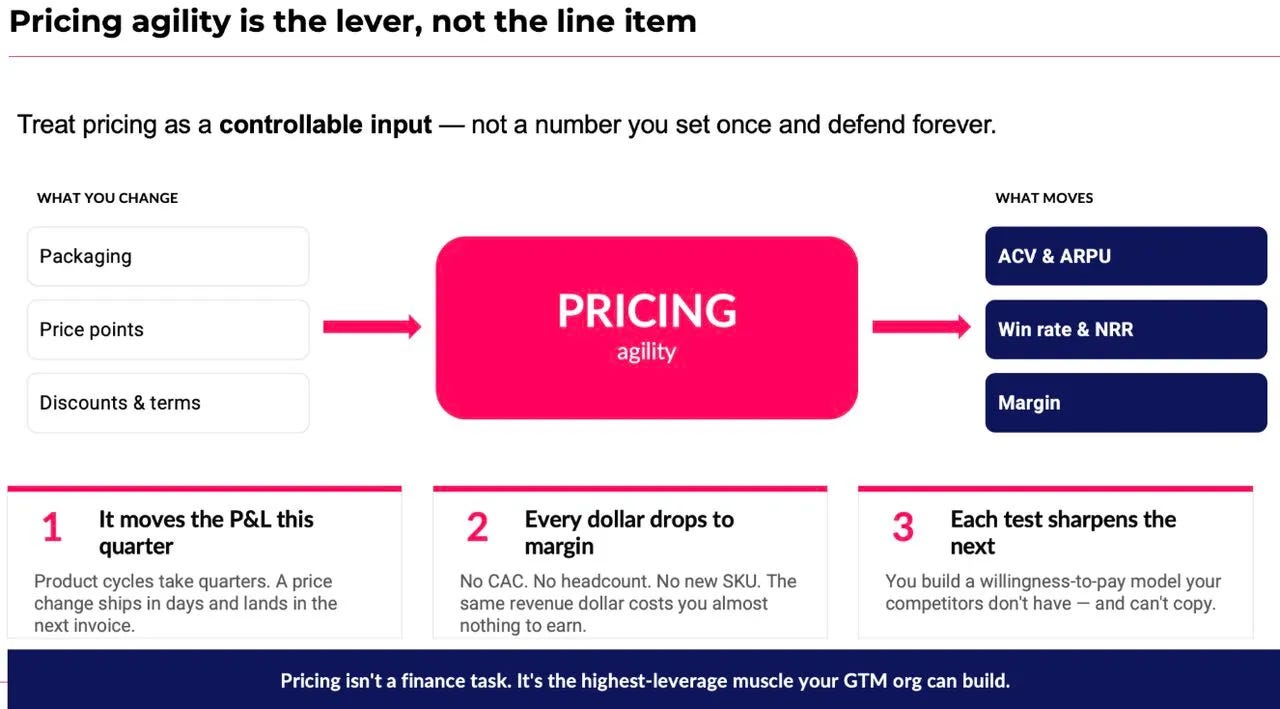
The core idea is that pricing should serve whatever the organization needs right now. Are we giving too much in discounts? We close the gap from 10% to 7%. We’re underpriced; we increase the listings. It always has been like this, but we had more time to think of it, analyze, and deliver.
Previously, you could do just fine:
1. Need more conversion or users? Drop a price, or add a low-tier plan
2. Need more margin? Seal the discount leaks, or raise prices on the heaviest users.
3. Competitor just launched a flash promo? Get louder on value communication.
Agility is all about being proactive, never passive. Pricing is to be used for offense, not defense! Like “heavy metal football”
Here are the things you can do to make it right:
Packaging - as mentioned before, play with the two-part tariffs; they are usually the safe bet to start with. Add-ons are mostly your best friends you haven’t met yet. Why kill your entire recurring revenue stream if you can simply add more layers to it? Think of your current client base as an existing market to sell to. You do it without yet thinking of GTM for new business.
Price points - this is actually interesting, because for years I was preaching: “don’t A/B prices”: the sample sizes were too small, you get local maxima, not the global ones. One of my most quoted articles on Valueships website was a list of reasons why you shouldn’t do it. It’s hilarious, but maybe I need to do the re-edition. One cornerstone of my narrative dropped within a few months. Honestly, I still believe there are strong reasons for when and when not to do it, and yet now you simply need to do it without overthinking. Try raising prices, reducing them, playing with anchors, magic numbers, observing the overall win rate and conversion.
Discounts - I will write a separate post on that, but this is literally an issue that hasn’t been resolved since the early days of merchants and trade, so about 4,000 years. People always want to pay lower prices, and sellers want to make a deal. This creates a friction that is as old as civilization. But to counter-paraphrase Bezos’ “your margin is my opportunity”, you can defend the monetization base with that. Do you track your discounts? Like honestly, can you even see how many of your customers are paying full price for the items they buy? Track this, and optimize on a monthly basis.
do we really need to go that fast?
The answer to that is: “yes, but with caveats”. You can’t afford to go completely clueless, so you better suit up for the challenge.
Track current clients and listings, and check what is feasible and what is not “in this iteration”. Don’t go for big bold bets of increasing the whole base by 50%. I had these cases where one big pricing change shifted the whole base. Now it’s probably not doable in one go.
Rather, you should treat pricing as a process and separate it as a discussion item during your board meetings. What can we change now? Will it directly affect our customer base and how? What are the risks?
This is where regular, embedded impact modeling comes in handy - if you don’t have it, build one. Ironically, you don’t need whole datasets. You will be just fine with good and reasonable “thought experiments”. Some examples:
Will a 30% increase reduce my base by 30%? If not, why hesitate?
Does it really hurt if we change the current packaging of our credits? Let’s say instead of 100 in the first pack, we give 50? Why not try this to test the consumption pattern? Most clients won’t notice.
If I’m building an add-on, should I really push for outcome-based pricing because “Intercom has it?” Or maybe I would do just fine with a basic consumption model and then figure out better attribution as we go? Whatever happens, it has already been shipped and is working, for better or worse.
While big 50% bets are probably not possible, having 3 or 4 of them providing a strong 6-8% uplift is a compounding effect on your revenue. Play this game, and you won’t fail. And if it goes wrong? My quote once told: “we can always CTRL+Z”.
But most importantly, you increase something even more important: a value-to-pricing mindset. You’re building an organization that has something that we scientists call: pricing capabilities. And if you don’t believe me, there is an actual great paper written by Stephen Liozu and Andreas Hinterhuber, peer-reviewed, on exactly that point.
So, back to your laptops and Excel, maybe with a little help from Claude or whatever you’re using. But stop reading this now; go push your pricing agenda to the market.
Onwards and see you next week!
Maciej Wilczynski, Ph.D.
Valueships, Managing Partner